A literary mythic fantasy of depth,
ambition, and a long memory.
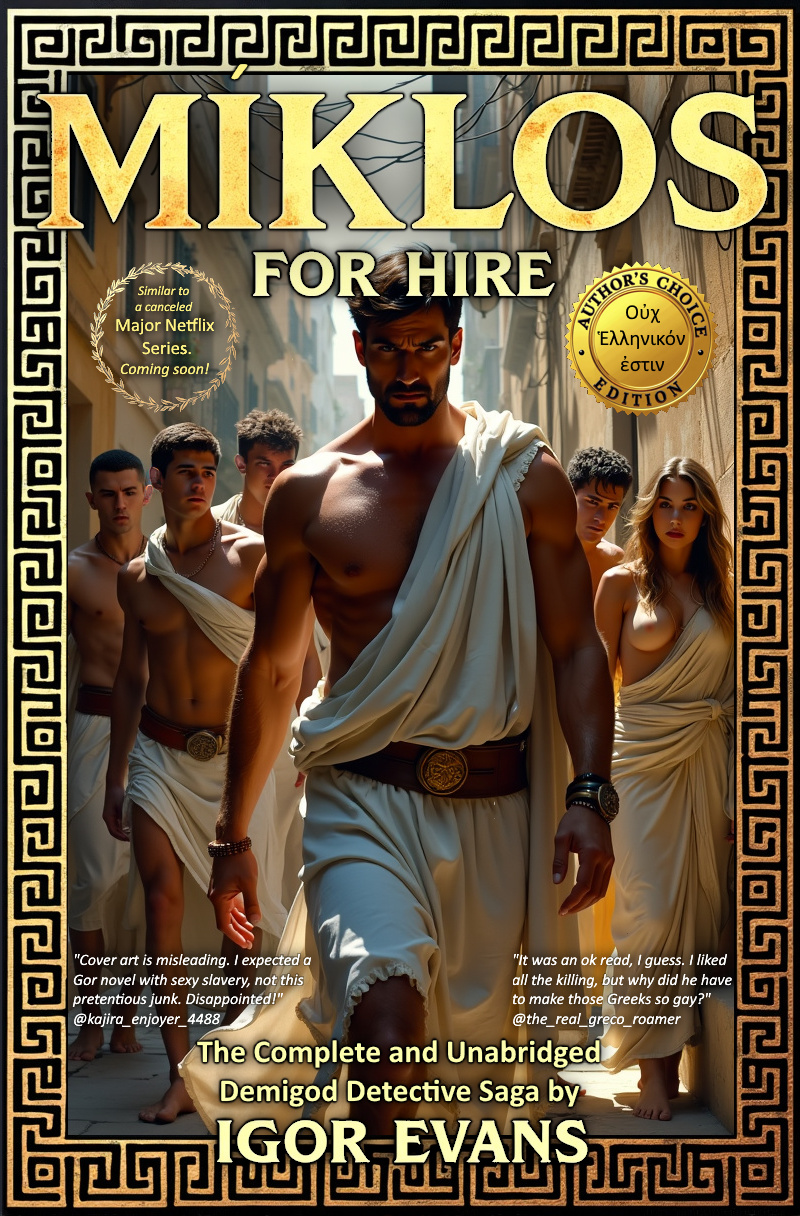
Míklos is a private eye with a private eye, a talent for self-mythology, and opinions so reactionary they’d make Spartans shift uncomfortably and excuse themselves.
A deposed demigod, he perpetuates his unfulfilling, unending existence by cleaning up divine scandals in a noir Iron-Age Greece. Here, in an ancient and unchanging realm, human life is cheap, the gods terrifyingly real, and magic more menacing than magical.
An unheroic protagonist and unreliable narrator, Míklos views the world through all three of his jaded eyes, filtering events through warped morals, thwarted ambitions, and a memory that refuses to let anything go. Moreover, despite having no sense of humor that he is aware of, he is disturbingly amusing.
When a routine job to silence some embarrassing undead nearly gets him dead, Míklos stumbles upon a deception long woven by the gods themselves. His quest to unravel this mystery and avert its catastrophe takes him from the depths of the ocean floor to the peak of Mount Ólympos. Thus is he driven to uncover the secrets of Creation and forced to answer for his oldest sins.
Long mired in divinely ordained stagnation, he and his world are dragged forward at last, with consequences no witness saw coming and no survivor will ever forget.
The novel is deliberate in its construction. The prose is elevated, ornate, and shaped by the cadences of classical oratory; the worldbuilding deep, cohesive, and historically grounded; the humor dry, bitter, and biting. This very text serves as a sample.
Voiced in the first person, the language exudes the narrator’s affectations, egotism, and inordinate love of Greek. It is accordingly seasoned with a veritable plēthṓra of such terms: transliterated, glossed, and hyperlinked as a matter of course.
The tightly structured text invites and repays close attention, revealing its substance over time by way of layered recurring themes, economically intricate plotting, and variably accessible meanings. Formal language, archaic rhythms, and elaborate mythology fuel brisk pacing, riveting action, and uncomfortable comedy.
Míklos’s portrayal is unflinching and unflattering, though not entirely unsympathetic. He is a complex character whose profoundly alien moral views reflect his failings, not ideals to be emulated, nor flaws tidily redeemed.
He philosophizes about mortality while squatting over corpses, justifies brutal violence with unassailable logic, and narrates combat with the casual detachment of a man filing paperwork.
Though vain, pitiless, and deeply flawed besides, he remains perversely relatable: not because he is admirable, but because the spectacle of his slow-moving self-destruction is impossible to ignore.
For those drawn to sophisticated storytelling, this tragicomedy offers rich rewards: a character study of immortal irrelevance with genuine emotional stakes, a fully realized mythic world, and dark humor in the shadow of looming apocalypse.
Think Gene Wolfe’s unreliable narrators meet Roger Zelazny’s world-weary immortals, only sharpened by Raymond Chandler’s hard-boiled detectives and rooted in Homer’s doomed epic heroes.
This is a polished work with a voice of its own. It is not a joyful romp, not a modernized ironic retelling, and not volume one of an interminable series. Instead, it offers a singular experience forged from seemingly incompatible elements.
If you appreciate literary fantasy that trusts the reader and offers more than escapism, this book was written with you in mind.
Come, step into the grin-dark world of Míklos. Just don’t expect him to be your hero.